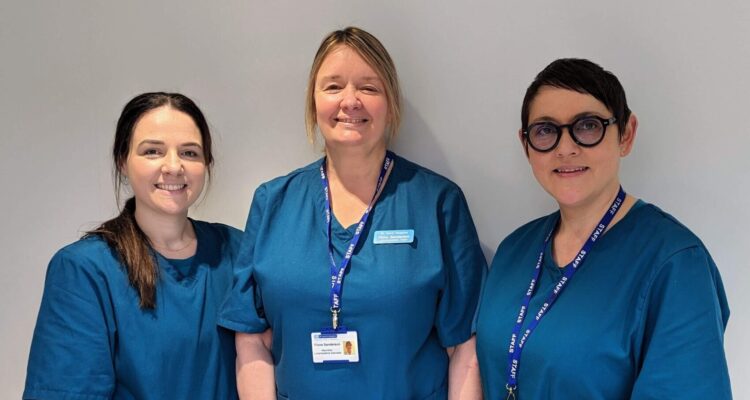
Moya Cole Hospice is celebrating World Social Work Week. The theme for this year, ‘Co-Building Hope and Harmony: A Harambee Call to Unite a Divided Society’, highlights the vital role of social work in bringing people together across communities, cultures, and systems to shape a more inclusive and sustainable tomorrow.
As part of World Social Work Week, the Moya Cole Hospice social workers as part of Patient and Family Support Team put together a Q&A about their work around the hospice.
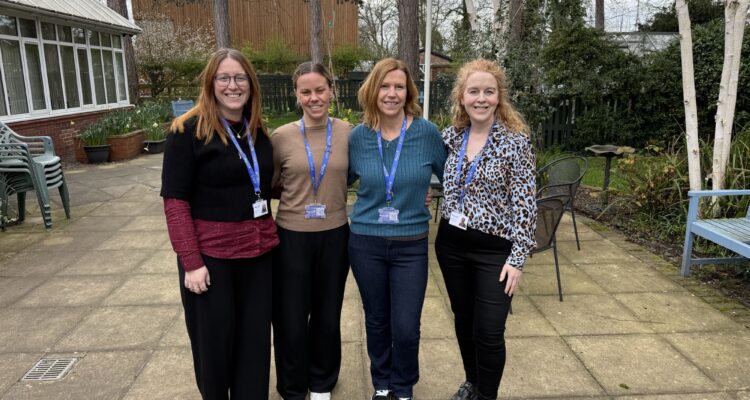
By Helen Barnfield, Jo Brown, Carina Woods, and Team Leader Joanne Rhodes.
Who are the social workers at Moya Cole?
There are four social workers who are part of the Patient and Family Support Team. Joanne Rhodes is the team leader, and also a qualified social worker, and works cross site. Jo Brown and Carina Woods are mostly based at Little Hulton; whilst Helen Barnfield is mostly based at Heald Green.
What is the role of a hospice social worker and how you support patients and families?
The role of a hospice social worker involves providing overarching, needs-led support to patients and families who access our services. The social work team take a lead on discharge planning, speaking with patients and their loved ones about their preferred wishes, facilitating discharge planning meetings, and liaising with other members of the multi-disciplinary team to formulate a safe and agreed-upon discharge plan.
We get involved in elements of advance care planning, e.g., advising on funerals, Wills, LPAs, and finances. In addition to practical support, we provide emotional support when someone needs a listening ear or reassurance. We advocate for and uphold the rights of our patients, ensuring their views and wishes are heard, whilst balancing the needs of patients, families, and the organisation as a whole. Often we act as mediators—supporting communication between patients and loved ones and negotiating differing views and opinions to determine a way forward. Ultimately, the main goal and focus of a palliative care social worker is to help and support the patient to achieve whatever they hope to achieve with the time they have left.
What does advocacy look like for a patient in hospice care?
Listening to the patient—what and who is important to them. Where and how do they want to be cared for? We ensure we understand the patient’s wishes and views, and if we can’t obtain these verbally, we consider alternative ways to communicate effectively. If we can’t communicate effectively with the patient we gather information from other sources e.g. whether they expressed their wishes previously to a family member or wrote something down.
Being person-centred and giving space for the patient to make their wishes known is a crucial part of our work. We facilitate conversations between patients, families, and professionals to reach a mutual decision if there are uncertainties or disagreements. We seek to promote a patient’s rights, e.g., around capacity and decision-making. A person may not lack capacity, but we may deem a decision they make to be unwise; nonetheless, they still maintain the right to make that decision. Advocacy is about actively supporting, speaking up for, and protecting the rights, needs, and wishes of our patients.
What misconceptions do people commonly have about hospice—and how do you address them?
A common misconception people have about the hospice is that once someone comes in, they are coming here to die. Yes, some people are admitted as they approach the end of their lives, but we also have patients who join us because they are struggling with symptom management or due to carer breakdown. The hospice supports people and families at some of the most difficult periods in their lives, and it is the function of the MDT to relieve some of that pressure and stress.
Some people may view a hospice as a fundamentally sad place, but interspersed with the sad times are many moments of laughter and joy. Sad things happen here, but a hospice is not necessarily a sad place to be. We support patients approaching the end of their lives to put their affairs in order, which brings a sense of relief and peace that they can let go of some of their previous concerns.
Another misconception might be the views people hold about social workers and what they do. We explain that our role is very different from that of a local authority social worker, and we are able to spend time with patients and families, offering our advice and support.
In what ways does the work of a hospice social worker make a measurable difference for patients and families?
Some elements of the social work role are more tangible than others, e.g. arranging a package of care or applying for Continuing Health Care funding. What is less easily measured is the difficult conversations we may have e.g. with a family member contemplating how to tell a child their dad is going to die; the reassurance given during a best-interest meeting; or easing a patient’s worries about how they will pay for their care. Our support doesn’t necessarily stop when a patient dies; family members may contact us to ask for advice about funeral planning or where to etc. The team works to help families navigate the system and alleviate concerns about what the future might look like.
How has working at Moya Cole affected you personally, and what do you do to take care of yourself in a role like this?
Jo:
I had wanted to work in palliative care since my nanna died in 2000. It was the first time I realised that approaching death is such an important stage of life. I have been proud to work at Moya Cole for the past 12 years and be part of a great team making a difference during people’s most difficult times. My main way of looking after myself is to use the team members around me to debrief and support. It can be an emotionally challenging role, but peer support helps me to decompress and carry on. Outside of work, I love to socialise, walk my puppy, and (reluctantly!) exercise to help me rejuvenate.
Carina:
Working at the hospice for the past three years has affected me in ways I didn’t anticipate. I appreciate how fleeting and precious our time on this earth is, and I care deeply about spending time with the people who matter. It makes me want to live life to the full and not be afraid to take chances or chase my dreams. I take care of myself by exercising regularly, being outdoors as much as possible, eating food I enjoy, and seeing the world with my family—whether on weekend walks or bigger trips.
Helen:
I have become much more grateful for what I have—health, family, and friends. I enjoy today and try to spend as much time as I can with the people who are important to me, because you never know what will happen tomorrow. I spend the drive home letting go of the day at work, turning the radio up, and giving myself ten minutes to clear my head. Once home, I spend time doing the things I enjoy—whether trips out with the kids, seeing friends, taking a long walk, or planning holidays. I like to have something planned to look forward to!
Joanne:
It is a privilege to work in palliative care, to be able to work closely with people at such a significant time in their lives. There are days that are particularly emotionally challenging. In this role I have learnt the importance of valuing the day to day, ‘the little things’, spending time with loved ones and making memories. Self-care is important, I love being outdoors enjoying nature, going for a run or pottering in the garden….I am ready to embrace Spring!