Paralympic gold medalist pays visit to St Ann’s Hospice for open discussion on end-of-life care

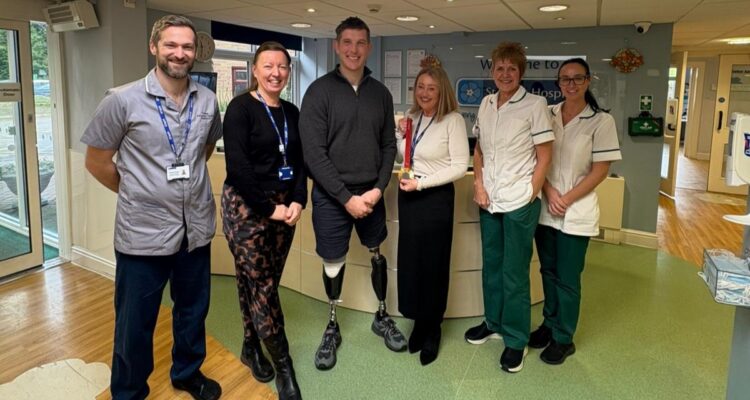
Paralympian gold medal rower, Gregg Stevenson paid St Ann’s Hospice a visit as he has an interest in health inequalities as he is currently studying at Manchester Metropolitan University.

Gregg was greeted by Director of Clinical Services, Emma Dixon; Head of Clinical Services, Emma Barclay; Rehab Team Lead, Frances Brown; Head of Fundraising, Anne-Marie Wynn; Trainee Advanced Clinical Practitioner, Bobby Magee; and Occupational Therapist, Jody Lee Jones.

As Gregg is interested in the treatment of individuals in end-of-life care, the hospice staff held open and honest discussions about their experiences with treating people with life-limiting illnesses and health inequalities in palliative care. He was also given a tour of the Heald Green hospice where he met with an inpatient

Gregg who is from Lancashire, lost both of his legs in an explosion while serving as a Royal Engineer Commando in Afghanistan 15 years ago.


I have an interest in health inequalities as I am studying at Manchester Metropolitan University. So, I’ve come here today to learn more about how we treat people in end-of-life care, and the word for me today that sums up my experience is dignity, treating people with dignity. We’ve been talking about a sense of belonging and identity and it’s just been an incredible experience, and I am really excited to see the work that is going to be happening in the future.


Gregg Stevenson, Paralympic Gold Medalist
Director of Clinical Services at St Ann’s Hospice Emma Dixon was “delighted” to welcome Gregg to St Ann’s.

“Gregg has spoken with us about the inspirational work that he has done, not only as a rower, but with NHS England, and the Veterans across the North-West, and I am really excited to work with Gregg moving forward in the future, and hopefully get his support with our new build,” Emma said.

Jody Lee Jones took part in an open discussion with Gregg at the Hospice following his arrival.

“Today, I’ve had the pleasure of meeting with Gregg Stevenson, and I’ve been able to share a patient story focusing on our rehab approach here at the Hospice, which links in with Gregg’s own journey, focusing on belonging and identity and how important that is for the people that we work with,” Jody said.

Bobby Magee said it was a “great opportunity” to meet Gregg.

“Gregg has been telling us about his life journey and his rehab focus and what got him to think about how he can improve not only as an individual but also how he can link that into the work he is currently doing with his Masters and his PhD, also linking in with the support he is doing for Veterans at the moment. There are loads of similarities and differences between what we can do and it’s about how we can link up and move together with all those connections in the future,” Bobby said.
St Ann’s Hospice hosts homelessness palliative care learning event

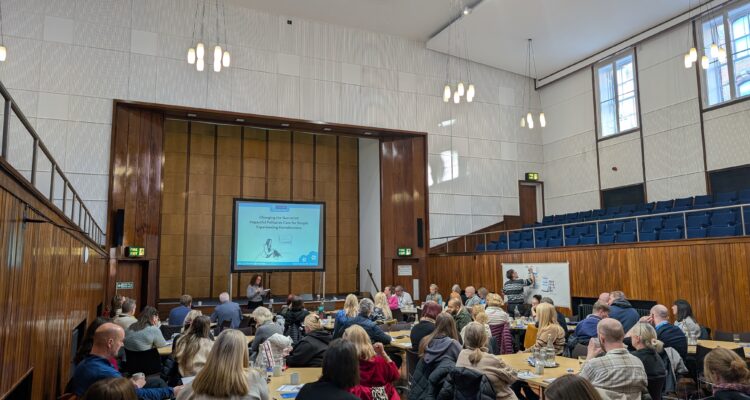
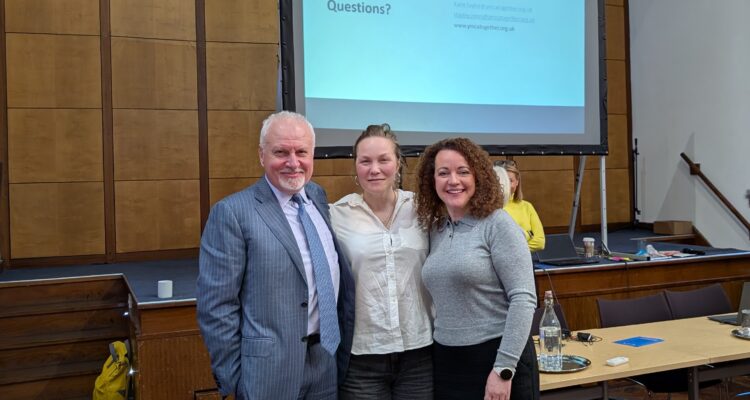
St Ann’s Hospice yesterday brought together professionals and frontline workers from heath, housing, local authority, social care and third sector services and sector-leading guest speakers at a learning event about the experiences of death and dying for people experiencing homelessness.

St Ann’s has been running a Homeless Palliative Care Service across the ten boroughs of Greater Manchester since 2020, funded as a five-year scoping project by the National Lottery Community Fund (formerly the Big Lottery Fund).

Colleagues, partners and collaborators from across Greater Manchester and beyond were invited to the event at Friends Meeting House in Manchester City Centre to hear the key findings from the project, to consider them together and drive meaningful change.

St Ann’s have this week published an evaluation report of the Homeless Palliative Care Service. As it stands, the service will end in January 2025 as further funding has not yet been secured.

Speaking at the event were Heidi McIntyre and Niamh Brophy, current and former Homeless Palliative Care Coordinators at St Ann’s; Professor James Kingsland OBE, a primary care physician, national clinical lead of a programme that addresses health inequalities across England and world authority on heathcare reform; and Dr Gemma Yarwood and Dr Gary Witham, senior researchers in Substance Use and Associated Behaviours at the School of Nursing and Public Health at Manchester Metropolitan University.

Also presenting were Dr David Waterman, Medical Director at St Ann’s and Greater Manchester Palliative Clinical Lead; Ryan Young, Inclusion Health GP Lead at Brownlow Homeless Health Inclusion Service in Liverpool; Hayley Jones, Director of Homeless Services and Katie Taylor, Director of Specialist Services at YMCA Hestia House in Liverpool; and Beth Plant, Funding Manager from the National Lottery Community Fund.

Many of the speakers touched on the fact that Manchester faces one of the most severe homelessness challenges in the UK, ranking third-highest for homelessness per capita.

People experiencing homelessness – in all its forms – are known to be one of the groups who experience inequitable access to palliative and end-of-life care.

As homelessness continues to rise across the UK, so too does the level of advanced, deteriorating ill health, which is reflected in the increasing number of deaths. Many of the day’s speakers emphasised the need for equitable access to palliative care being essential to improve the experience of death and dying for people experiencing homelessness. Often this can mean people dying as comfortably as possible, in a dignified way, in a place of their choosing.

Rachel McMillan, Chief Executive of St Ann’s, opened and closed the event. She said:

“This event represents an invaluable opportunity to come together with a common purpose: addressing the critical needs of people experiencing homelessness who are facing life-limiting illnesses. Homelessness is compounded by unmet health needs and shortened life expectancy. This work is more urgent than ever. Together, we will discuss how we can expand our reach and deepen our impact.


By uniting our knowledge and resources and having a mindset of collaboration, we can build a healthcare system that is more accessible, inclusive, responsive, and compassionate, ensuring that support reaches everyone who needs it.


Rachel McMillan, Chief Executive, St Ann’s Hospice

The theme of collaboration was echoed throughout the day by speakers and attendees.

Since St Ann’s launched the Homeless Palliative Care Service, it has delivered over 131 case-managed interventions, provided more than 250 digital services to reduce exclusion, and offered significant and consistent in-reach support to high-need hostels.

Rachel said: “Our trauma-informed, flexible approach has shown the profound impact that inclusive, tailored care can have on those who might otherwise feel invisible within the healthcare system.”

Emma Dixon, Director of Clinical Services at St Ann’s, hosted the event, and Emma Barclay, Head of Clinical Services, conducted a multi-disciplinary team (MDT) panel discussion focusing on a case study of a person experiencing homelessness who was cared for at St Ann’s Hospice in the last year, highlighting both the positive outcomes achieved and the challenges of this work.

The event was closed with a call to action for those in the room to commit to improving outcomes for those experiencing homelessness.


By investing our time, resources, and collective commitment, we can ensure that no one, regardless of their circumstances, faces their journey alone. Let’s seize this moment to drive meaningful change, expanding support and improving outcomes for those experiencing homelessness in our communities.


Rachel McMillan, Chief Executive, St Ann’s Hospice

The evaluation report of the Homeless Palliative Care Service at Ann’s Hospice is available to download from our website here.

For more information on the Homeless Palliative Care Service, or to make a referral if you are a health or social care professional (including support workers and hostel staff), see our website here.

If you have any questions or would like to discuss anything with our Homeless Palliative Care Coordinator, please email Heidi McIntyre at HMcIntyre@sah.org.uk.

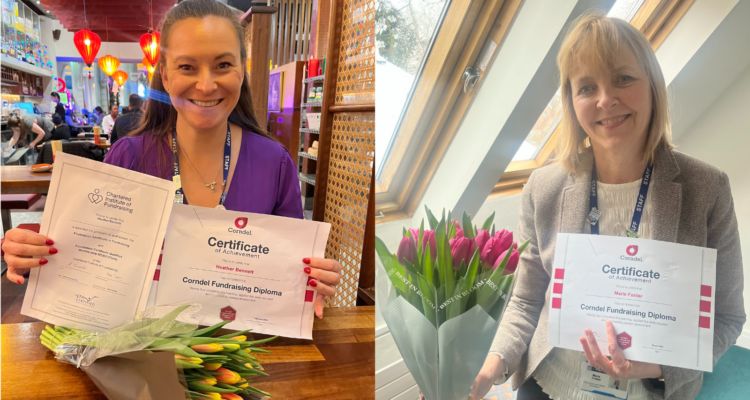
St Ann’s fundraising team members gain diplomas

Two St Ann’s Hospice employees recently took the next step in their fundraising careers and successfully gained their Level 3 Fundraising Diplomas.

Marie Foster, Innovation and Digital Fundraiser, and Heather Bennett, In-Memory and Legacy Fundraiser, both completed the Level 3 Fundraiser Apprenticeship, which was fully funded via the Corndel Levy Pledge in partnership with Hospice UK. This is a professional development programme which uses gifted levy funds to enable learners to gain qualifications without any cost to the hospice.

The course also gave the team members a professional qualification, the Foundation Certificate in Fundraising and Foundation Certificate Qualified Membership MCIOF (FCert).

Marie has been a key member of St Ann’s Fundraising Team for over five years.


When I started the course in January 2023 it was with the aim of increasing my knowledge on all aspects of fundraising and putting my learning into practice here at the hospice to make me a better fundraiser. The bonus was gaining a professional qualification after assessment at the end of the course.

I’ve enjoyed the learning over this past year and also the opportunity to meet other UK hospice fundraisers. Although it was difficult at certain times, it was worth it to gain the qualification – and it’s always good to push yourself out of your comfort zone!


Marie Foster, Innovation and Digital Fundraiser

Heather, a former solicitor, has worked in the team for almost two years, having previously volunteered on the ward at the Little Hulton hospice.


It was so important to me to learn about the wider workings of fundraising and how we as a hospice, and I in my own role, can be there for our wonderful supporters.

Having a wider understanding of the importance of fundraising for charitable organisations means I can in turn be a better fundraiser for our supporters. Whilst at times the course was challenging, I feel very lucky to have had the opportunity to learn more about the charitable sector.


Heather Bennett, In-Memory and Legacy Fundraiser

Everyone at St Ann’s would like to congratulate Heather and Marie on their commitment and achievements.

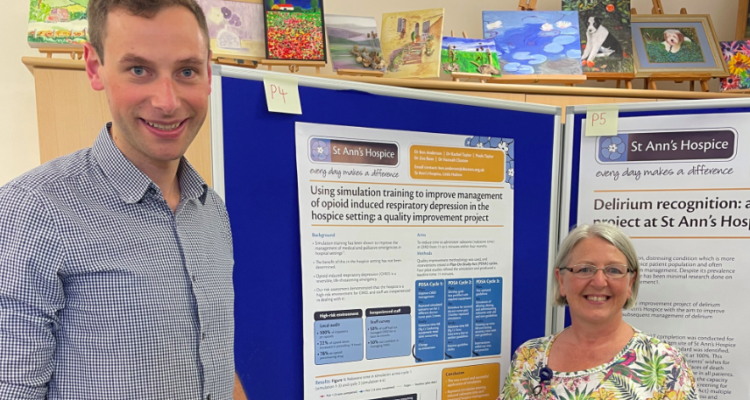
First Audit and QI Seminar at St Ann’s a great success

The first annual Audit and Quality Improvement Seminar was held at St Ann’s Heald Green Hospice on Wednesday 21st June.

The event was organised by Katherine Lamb, Quality and Governance Lead, and Consultant Dr Lesley Henson. There were five presentations and 12 posters showcasing the clinical audit and QI work at the hospice over the last 12 months.

The presentations were from Dr Sarah Clelland, Fran Brown, Dr Ben Anderson, Jennifer Forsyth and Dr Roisin Porteous.

The posters and presentations were judged by a panel made up of Medical Director Dr Dave Waterman, Heald Green Ward Manager Louise Pinney, and Trustee Melanie Ogden.

The winners of the Best Poster were Fran Brown, Emma Barclay and Emma Dixon for their poster ‘How a rehabilitative approach helped us to transform patient outcomes and our hospice culture.’

The winner of the Best Oral Presentation was Dr Ben Anderson for his presentation ‘Using simulation training to improve management of opioid induced respiratory depression in the hospice setting: a quality improvement project’.

Katherine said: “We are always looking for ways to improve and develop our services and strive to provide the best possible care for our patients. The seminar was a great opportunity for clinicians and other colleagues from across the hospice to come together, review some of the amazing quality improvement projects carried out over the last 12 months and share best practice and ideas.”

Feedback after the event was very positive with one attendee saying: “Really motivating and inspiring to see what has been done.” Other feedback praised the session for being “educational and forward thinking.”

Fiona wins bronze award at the British Journal of Nursing Awards

Fiona, a lymphoedema specialist at St Ann’s Hospice, collected a bronze award at the British Journal of Nursing Awards 2022.

The honour took her by surprise as she was even unaware she had been nominated and she is not actually a nurse, her prize coming in the Chronic Oedema Nurse of the Year category.

Fiona, who is also affiliated to Macmillan in her role as a palliative care specialist, has treated patients at Heald Green and Little Hulton in nine years at St Ann’s.


I feel slightly embarrassed by the award, but it’s nice to get the recognition for our lymphoedema work and, if anything, it highlights how important our services are.

I love my job and making a difference to people who might have been searching for treatments over a long time to help them manage their condition. It’s an under-staffed and under-resourced service in this country.

More people than you think suffer from lymphoedema, which can lead to other problems like wounds, infections and sepsis.

“People with cancer can experience lymphoedema, but it can also be congenital or occur due to other conditions such as vascular problems and cellulitis.

It limits what people can do in their life. One lady I treated recently had swollen ankles and couldn’t get her shoes back on after not going outdoors for two years in the pandemic. After three weeks of treatment, she was able to send us a photo of her at her local restaurant.
People are grateful there’s a service out there which helps them get a better quality of life.


Fiona Sanderson

Lymphoedema is a swelling caused by an impaired lymphatic system and affects any part of the body. Most common areas are arms or legs, but the head, neck, breast, abdomen and genital area can also be affected. It is estimated that lymphoedema affects between 263,000-422,000 people in the UK

Support for you

When you’re living with a life-limiting illness, you can experience physical, psychological, emotional or social issues which mean that you don’t quite feel like you.

The Being You Centre at St Ann’s is here to help you get back to feeling like yourself again.

Find out about The Being You Centre


Equity of care

Sadly, for many reasons, there are lots of people from local communities that historically haven’t had access to the same levels of health care as they deserve. 

There are lots of reasons for this, but at St Ann’s we believe that everyone, whatever their background and whoever they are, deserves the same high quality care at the end of their life as they do when they’re born. 

Sometimes palliative or end of life care can be seen as less of a priority, but ensuring people access to specialists and other experts, are listened to, and that their wishes are met as fully as possible as they near the end of life is so incredibly important – and it also helps those closest to them.  After all, we don’t stop being ourselves when we are nearing the end of our life; we still have things which are important to us, that we want to do and share, and goals we want to achieve. 

A recent announcement that hopefully palliative care is to be specifically recognised within health legislation for the first time in England, with a possible amendment to the Health and Care Bill, is a significant step forward in the statutory footing of palliative and end of life care.  This recognises the importance of these services, and also highlights the need for proper funding for the care of patients with palliative and end of life needs.  We are hoping this will lead to an even greater focus on the importance of specialist care for local people and will be watching developments closely – being loud and proud about the importance of that care. 

When it comes to hospices, there are many communities that historically haven’t always thought of us as a place that might be able to support them or their loved ones.  Whether that’s because of religious beliefs – many presume we are a Christian organisation because of our name, when actually it’s because our first hospice site is situated on St Ann’s Road North in Heald Green – cultural, or other individual reasons, we’re really keen to break-down barriers and reach as many members of our local community as possible. 

We’ve been doing lots of projects to spread the word about our care, and how it can benefit people right from the point of diagnosis of a life-limiting illness, right through their treatment and beyond.  We’ve been developing services too, aimed at reaching into a variety of communities at the heart of our city to improve access to specialist hospice care for anyone who needs it. 

For example, our award-winning homeless palliative care service is there to support people without a home who have a life-limiting illness, acting as a vital cog to join together various spokes of social and health care across the city. Those we’ve worked with have given their appreciation, whether that’s for supporting them through their illness, helping them to get their affairs in order, reconnecting them with loved ones, or supporting those who have suffered a bereavement.   

We’ve also been reaching out to members of the LGBT+ community to help improve access to our services, as well as people in prison, and individuals with learning disabilities. 

We know that while there’s a huge amount of work going on in this area, there’s still lots to be done, but we’re really proud of the work we’ve been doing to improve the lives of local people.   

We’re always keen to spread the word and improve access to care for all, so do get in touch if you’d like to know more. 

Interested in reading more news stories from St Ann’s?

Our news page is right

Here!


St Ann’s Hospice has launched a brand new training and education programme

Staff training session

Highlights in the coming months include ‘Basic skills for teaching and training’, and a workshop which gives an insight into ‘Inequalities in palliative care’, particularly for professionals supporting members of the homeless, LGBTQ+ communities and people with learning disabilities who have traditionally faced  barriers when accessing end of life care. 

There will also be courses on how to support patients with symptoms of breathlessness and fatigue, and a raft of bitesize courses both online and in person which cover a range of topics in the field of palliative care.  The bitesize sessions can be booked for just £15, or can be purchased in a pick and mix bundle for use by an individual or across an organisation at £100 for 10.  Topics include how to recognise when someone is dying, symptom control, communication skills, frailty, and dementia and end of life care, and lots of other topics to empower and educate staff supporting people with palliative and end of life care needs. 


As an organisation with more than half a century of experience in palliative and end of life care, and also in delivering innovative projects across non-clinical departments as well, we’re passionate about sharing our knowledge with others. This schedule of training and education courses is something we’re really excited about, and it has been designed to reflect some of the key topics in palliative and end of life care currently. We’re hoping professionals from the local area and beyond will want to join us either in person or online to help refresh and expand their skills and knowledge. We have people from a wide variety of backgrounds who join us for the training, whether that’s from hospital, hospice or other healthcare settings, or from care homes and other social care providers. We’re always happy to support people with their training needs, so would always encourage people to get in touch if they do have specific requirements too.


Jude Holt, Head of Practice Development at St Ann’s Hospice

St Ann’s Hospice is one of the oldest and largest hospices in the UK and provides care from its two sites in Little Hulton and Heald Green as well as via a range of community and outreach service.  The organisation celebrated its 50th anniversary last year, and with its current Heald Green building dating more than 100 years old, is currently embarking on an ambitious project to build a new hospice in Heald Green on land adjacent to its current site to meet the future care needs of local people. 

For further details about the training courses being run by St Ann’s Hospice, or to book a place, please visit moyacole.org.uk/training or contact Abby Evans on education&training@sah.org.uk or 0161 498 3616. 

Rachel McMillan’s latest blog – Collaborations for the future

Look at the recent partnership with Greggs and Primark, for example – sausage rolls and t-shirts don’t have an obvious synergy, but their collaboration has been reported in the press and on social media too, with sales doing brilliantly. Their partnership is definitely not a pasty… 

But, many people don’t realise that in health and social care, partnerships are critical to what we do too.  Working in collaboration with others is the best way to ensure excellent care for patients and it’s vitally important. 

With headlines rightly focusing on the NHS, especially during the pandemic, we’re all acutely aware of resourcing and pressures that teams are under. 

But, when thinking of that big health and social care picture, it’s also important to remember charities and other organisations who work alongside the NHS to ensure patients and those closest to them receive the very best holistic care. Partnerships are key to enable care that truly wraps around the patient whether in hospital, in the place they call home, or out in the community. 


At St Ann’s, collaboration is also at the heart of everything we do.  Whether that’s supporting NHS colleagues or sharing our specialist knowledge and expertise, working alongside others is incredibly important. 


A great example I’m really proud of is that we’ve recently joined forces with The Christie to provide chemotherapy services and other anti-cancer treatments at our Little Hulton hospice site.  In practice, this means that some patients who live in Salford or near to Little Hulton no longer need to cross the city to go to The Christie hospital for their treatment.  They can simply come to our hospice instead. 


We’ve had great feedback from the patients who have done so, including one man who lives in Little Hulton and was thrilled he could walk to and from his treatment, rather than have to get multiple buses.  It may sound like a simple project, but it’s one that has really improved the experiences of local patients, and that makes us proud. 


We’ve also been working with members of the homeless community in the city centre, helping to improve the experiences of homeless people who may need palliative or end of life care.  Teaming up with professionals from across the sector, whilst sharing our specialist knowledge, has meant that we’ve been able to improve the lives of homeless patients, whilst also helping to ensure that their needs and wishes are better met, especially as they near the end of their life.  This can only be achieved with a fully joined up approach, working with the various agencies and individuals, to achieve the best outcomes. 

There’s also a really exciting partnership in progress with the University of Salford, who we’ve collaborated with to deliver an exciting palliative care focused leadership and management masters programme for clinical leaders and future leaders.  It’s really great to be able to share our knowledge and expertise with others, and to help equip healthcare professionals with the tools to deliver even better care for patients and those closest to them. 

Collaborations like these take time to build and deliver, and they’re not always talked about as much as the sausage rolls and t-shirts of this world might be.  But, with them, the care patients and their families receive is truly better, and that’s definitely worth shouting about. 

Find out more about our different services and partnerships

Click here