Rose is making Moments that Matter through complementary therapy
This spring, we’re asking for your help to make Moments that Matter. Hear from Moya Cole Hospice's complementary therapist, Rose Grundy, about how she helped make Moments that Mattered to our patients. You can donate or learn more by visiting the link at the bottom of this article
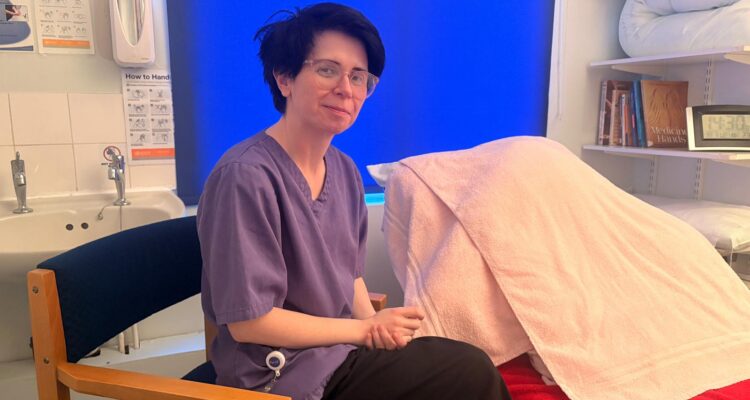
In 2025, Rose Grundy, a complementary therapist at Moya Cole Hospice, was introduced to a patient who was restless at night in the hospice wards. Her work to meet the need of the patient earned her a Chair’s Award from the hospice Board of Trustees in September of the same year.
“She had lung cancer as well as dementia,” Rose said. “I have been trained in massage and aromatherapy for people with dementia.
“There’s normally a reason why someone is restless at night. It’s often due to an unmet need. You have to try and get to know a lot about the patient. I found out that she was really used to a busy life, and she loved to garden.
She really wanted to be outside. Initially, I encouraged the other complementary therapists that if that’s what she wants, her therapy for the day could be going outside into the garden under supervision. Her ability to walk changed so she became a higher risk of having a fall when moving, so she couldn’t go outside anymore Rose Grundy, Complementary Therapist, Moya Cole Hospice
Rose continued: “Another tool to use with people with dementia is to validate what’s going on for them. I acknowledged that it must be really frustrating for her not to be able to go outside. This immediately started to calm her down…I then did a guided meditation with her around a garden. I got her to close her eyes. I played some bird song noises. I got the different smells of the garden such as rosemary and peppermint and wafted them under her nose on a tester strip. All of this helped her, and she wasn’t restless again after that. It’s all about meeting the needs of the patient,” she said.
Another example of Rose creating a moment that mattered was when a patient wanted a spa day. This patient came to the hospice and had previously been turned away from a spa because of her cancer diagnosis and a lack of suitably trained therapists at the spa.
I got some nice flickering battery-powered candles. I got the smells you would typically have in a spa, I had some spa like music, we got some nice towels in, and different lighting to recreate that environment. It was a really special moment I got to be involved with Rose Grundy, Complementary Therapist, Moya Cole Hospice
Complementary therapies are used alongside medical treatments. They help manage symptoms, reduce stress, and improve quality of life. They include Reflexology, Massage, Aromatherapy and Reiki.
Part of the theory of Reflexology is the idea that you have map of the body on your hands, your feet, your face, and your ears. At the hospice, treatments are typically carried out on the feet or the hands.
“Because we are able to target certain parts of the body, we may be able to help with certain symptoms someone has,” Rose said. “We can try to induce the relaxation response.”
We can’t always guarantee reflexology will work because everybody is different, but often it is beneficial, and I’ve seen it be beneficial straight away Rose Grundy, Complementary Therapist, Moya Cole Hospice
Aromatherapy is a complementary therapy using essential oils such as lavender, peppermint, and eucalyptus smithii to enhance physical and psychological well-being.
“Essential oils have different therapeutic benefits that can be really profound. With our patients with dementia we can use lemon oil which may help with neuroplasticity and memory,” Rose said.
Some studies show that lemon oil shows potential improvements of up to 226% in cognitive function.
Reiki is another complementary therapy that is offered in the hospice and which Rose also practices. Reiki is a technique that originated in Japan.
We have to be guided by the patient. It depends on what is comfortable for them. Reiki can involve the gentle placing of the hands on the body or the practitioner can hover their hands over the person’s body, without touch Rose Grundy, Complementary Therapist, Moya Cole Hospice
“The idea with Reiki is that the practitioner is a channel for universal energy. They become attuned to it. Even if the practitioner can’t reach certain parts of the body, Reiki is smart energy; it goes where it needs to.
“Reiki, here, is about inducing a sense of relaxation and a greater sense of wellbeing” Rose said.
According to Rose, it is all about learning about the patients in Moya Cole Hospice, understanding what works for them, what their needs are, and trying to make a difference for them.
“It’s really beautiful work. It is a privilege.” Rose said.
To help make more Moments that Matter at Moya Cole Hospice or to learn more about our Spring Appeal, click here.