
Expert Voice: Emotional intelligence impact on nurse leaders’ ability to become effective leaders
Being You Centre Team Leader, Amanda Connors showcased this topic at the National Hospice UK Conference in Liverpool
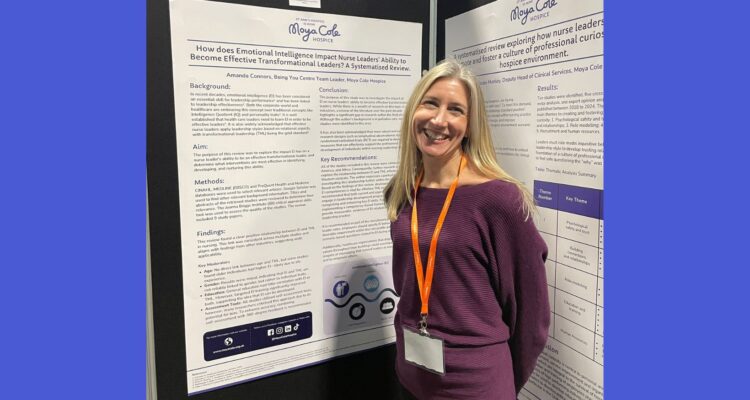

Amanda Connors
Being You Centre Team Leader
Contact Amanda
Contact communications@moyacole.org.uk
How does Emotional Intelligence Impact Nurse Leaders’ Ability to Become Effective Transformational Leaders? A Systematised Review.
By Amanda Connors, Being You Centre Team Leader, Moya Cole Hospice
Background:
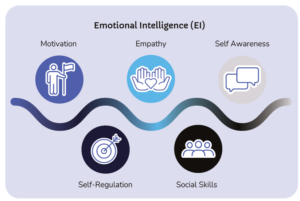
In recent decades, emotional intelligence (EI) has been considered an essential skill for leadership performance (1) and has been linked to leadership effectiveness (2). Both the corporate world and healthcare are embracing this concept over traditional concepts like Intelligence Quotient (IQ) and personality traits (3). It is well established that health care leaders need to learn EI in order to be effective leaders (4). It is also widely acknowledged that effective nurse leaders apply leadership styles based on relational aspects, with transformational leadership (TML) being the gold standard (5).
Methods:
CINAHL, MEDLINE (EBSCO) and ProQuest Health and Medicine databases were used to select relevant articles. Google Scholar was used to find other relevant background information. Titles and abstracts of the retrieved studies were reviewed to determine their relevance. The Joanna Briggs Institute (JBI) critical appraisal skills tool was used to assess the quality of the studies. The review included 9 study papers.
Findings:
This review found a clear positive relationship between EI and TML in nursing. This link was consistent across multiple studies and aligns with findings from other industries, suggesting wide applicability.
Key Moderators:
- Age: No direct link between age and TML, but some studies found older individuals had higher EI—likely due to life experience.
- Gender: Results were mixed, indicating that EI and TML are not reliably linked to gender, but rather to individual traits.
- Education: General education had little correlation with EI or TML. However, targeted EI training significantly improved both, supporting the idea that EI can be developed.
- Assessment Tools: All studies utilised self-assessment tools, however, many researchers criticised this approach due to its potential for bias. To enhance accuracy, combining self-assessment with 360-degree feedback is recommended.
Conclusion:
The purpose of this study was to investigate the impact of EI on nurse leaders’ ability to become effective transformational leaders. While there is a wealth of research on this topic in other industries, a review of the literature over the past decade highlights a significant gap in research within the field of nursing. Although the author’s background is in palliative care, no relevant studies were identified in this area.
It has also been acknowledged that more robust and extensive research designs such as longitudinal observational studies and randomised controlled trials (RCT) are required to develop reliable measures that can effectively support the professional development of individuals within nursing leadership roles.
Key Recommendations:
All of the studies included in this review were conducted in Asia, America, and Africa. Consequently, further research is needed to explore the relationship between EI and TML effectiveness in Western contexts. The author expresses a particular interest in investigating this relationship further within the United Kingdom. Based on the findings of this review, developing and maintaining EI competencies is vital for effective TML in nursing. It is therefore recommended that both current and aspiring nurse leaders engage in leadership development programmes that focus on recognising and enhancing key EI skills. Furthermore, implementing a competency-based framework is advised to provide measurable evidence of EI-related behaviours in leadership practice.
It is recommended as part of the recruitment process for nurse leader roles, employers should specify EI behaviours as a desirable requirement within the role profile and incorporate scenario-based questions related to EI during interviews.
Additionally, healthcare organisations that display their core values throughout their buildings could accompany these with slogans or messaging that remind leaders to lead with empathy and to empower others.
References
(1) Goleman D. Emotional Intelligence. Bantam, 1995.
(2) Dulewicz C, Young M, Dulewicz V. The relevance of emotional intelligence for leadership performance. Journal of General Management. 2005;30(3):71-86.
(3) Dhani P, Sharma, T. Emotional intelligence; history, models and measures. International journal of science technology and management. 2016;5(7):189-201.
(4) Nightingale S, Spiby H, Sheen K, Slade P. The impact of emotional intelligence in health care professionals on caring behaviour towards patients in clinical and long-term care settings: Findings from an integrative review. International Journal of Nursing Studies. 2018;80(80):106-117.
(5) Cope V. Murray M. Leadership Styles in Nursing. Nursing Standard. 2017;31(43):6170.